
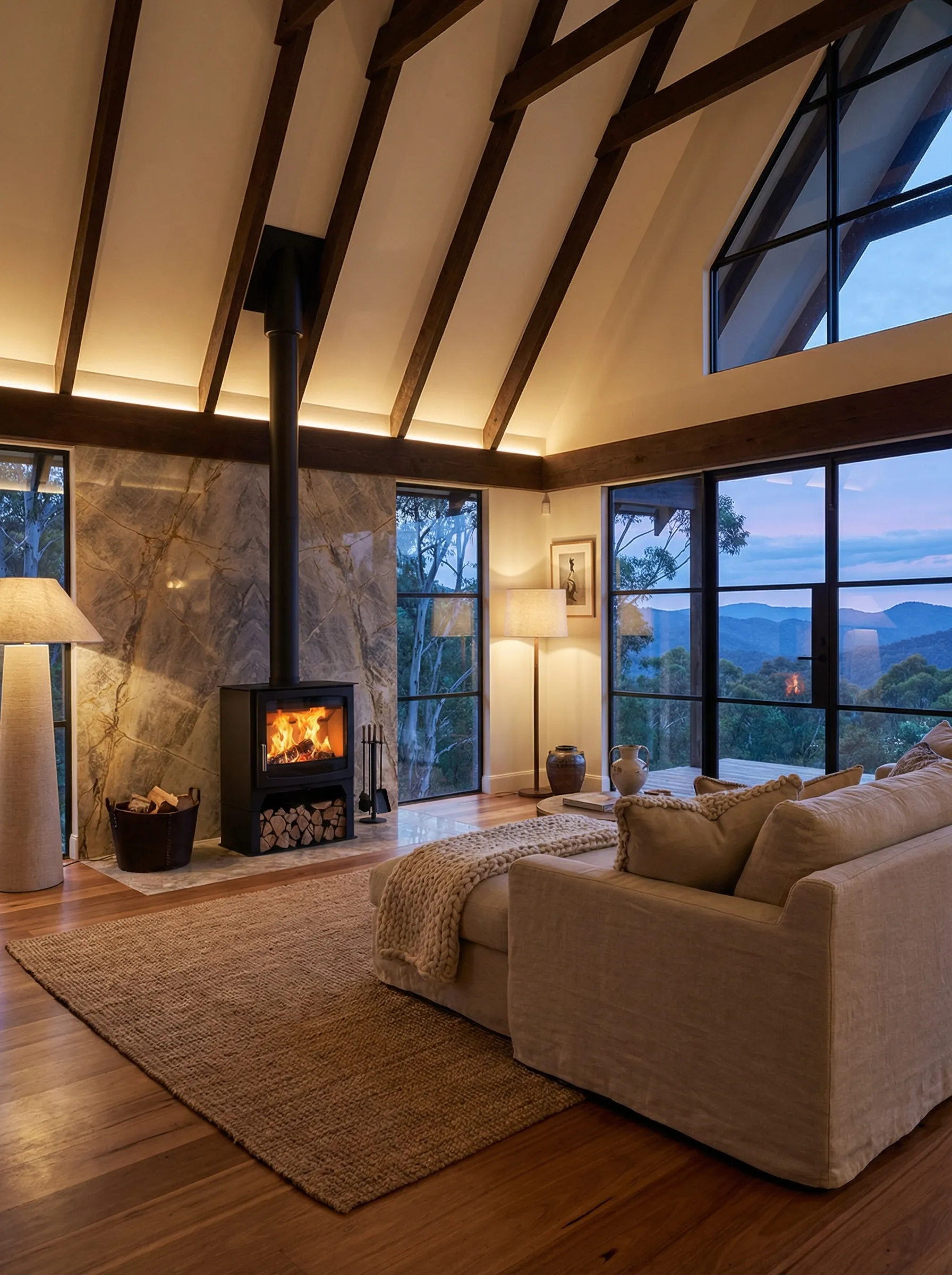
What size wood heater do I need
Choosing the right size wood heater is the decision that most affects how you feel about it afterwards. Too small and the room never gets warm. Too large and you end up running it low, which wastes wood and can foul the glass and flue.
This guide explains how heater output relates to the area it heats, what changes the answer, and how to work through a real example.
What kW and “heats up to” actually mean
A wood heater’s output is measured in kilowatts (kW). That is the rate at which it puts heat into the room. Manufacturers usually quote two figures.
Peak output is the most the heater delivers at its hardest. Average output is what it delivers across a normal burn. Average output is the more useful number for sizing, because you will spend most of your time there.
Manufacturers also quote a heating area in square metres. Treat it as a guide only. It assumes a typical home. Yours may not be typical.
For the Parkray Aspect Eco range, the manufacturer’s guides are:
- Aspect 5 Eco: average output 6.6kW, heats up to 140 sqm
- Aspect 8 Eco: average output 8.1kW, heats up to 195 sqm
- Aspect 14 Eco: average output 8kW, heats up to 220 sqm
These are guides. They are not promises.
What changes the answer
Four things matter more than the number on the box.
Ceiling height. Heat is spread through a volume, not a floor. A room with a raised or cathedral ceiling holds far more air than the same floor area under a standard ceiling. Hot air also rises and sits near the roof, away from you.
Insulation. A home with good ceiling insulation, wall insulation and sealed windows keeps the heat it gets. An older, draughty home loses it as fast as it arrives. The same heater suits a bigger area in a well-sealed house.
Climate. A heater that is generous in a mild coastal winter may be marginal in the tablelands or the high country. Colder, longer winters ask more of the appliance. Think about your coldest weeks, not your average ones.
Layout. A single closed room is the easy case. An open-plan layout is harder, because the heat spreads into the kitchen, dining area and hallways. Doors that stay open, stairs and a second storey all change where the warmth goes.
Do not size to your coldest day alone
It is tempting to buy the biggest heater to be safe. That is a mistake. A heater that is far too large for the room will need to run on a low setting to avoid overheating you. Running low is the opposite of a clean, hot burn. It is harder on your flue and glass and gives you less for your wood.
Aim for a heater that suits the space when it runs at a steady, healthy burn. If you are between two sizes, discuss the trade-off with your dealer.
Worked example: a 150 sqm open-plan home
Imagine a single-storey home with a main living, dining and kitchen area that is open plan. The total space you want to warm is about 150 sqm. The ceilings are standard height, and the home has average insulation. The climate has cool winters.
Here is how to reason through it.
- Start with the area. At 150 sqm, the space is more than the Aspect 5 Eco’s manufacturer guide of up to 140 sqm. That model is worth ruling out unless the home is exceptionally well insulated or you only want to heat part of the space.
- Test the Aspect 8 Eco. Its guide is up to 195 sqm, which sits comfortably above 150 sqm. It is the natural first candidate.
- Adjust for the conditions. Standard ceilings and average insulation do not push the answer up. If the ceilings were raised, or the home draughty, you would weigh the Aspect 14 Eco instead.
- Consider layout. Open plan means the heat has to travel. Position matters. A heater near the middle of the open area works better than one tucked into a far corner.
- Check the practicalities. Placement, hearth, flue route and clearances decide what can physically go where.
For this home, the Aspect 8 Eco would be the likely shortlist. Change one variable, such as a vaulted ceiling or a cold climate, and the Aspect 14 Eco comes into play. Change the other way, to a small, tight, well-insulated home, and the Aspect 5 Eco becomes a real option.
Mapping the models to typical cases
- Smaller home, single room, well insulated, mild climate: the Aspect 5 Eco. Peak output 9.6kW, 79kg, 8 hour burn time.
- Average family living area, open plan or not, standard ceilings: the Aspect 8 Eco. Peak output 11.3kW, 105kg, 10 hour burn time.
- Large open-plan space, high ceilings, colder climate or a draughty home: the Aspect 14 Eco. Peak output 14.1kW, 130kg, 12 hour burn time.
For a full table of every specification, read our side-by-side comparison.
Fuel and operation still matter
Even a correctly sized heater underperforms on wet wood. Firewood should be below 20% moisture. Our guide to seasoning firewood shows how to get there. Good operation, such as keeping the air supply open long enough after loading, makes a difference too. Our article on lighting your wood stove covers the basics.
Let a dealer size it properly
A guide on a screen can get you to a shortlist. It cannot see your ceiling, your windows or your floor plan. A Hunter Stoves dealer can. They will also check the hearth, clearances and flue route, which decide what can be installed. Installation must be by a qualified installer to AS/NZS 2918.
Hunter Stoves Australia sells only through authorised dealers. Use the dealer locator to find one near you, or phone 1800 064 234. You can also browse the full range first.
Ready to find your heater?
Browse the full Parkray Aspect Eco range.